GOVERNMENT OF INDIA BOND RATE AS ON 30 MARCH 2026
As per the IND AS 19 Guidelines issued by the Ministry of Corporate Affairs, to decide upon the rate of discounting for the post employment benefit obligations, it is suggested to used the yields on long term Indian Government bonds.
The yield rates below are comprised of Generic Indian government bills and bonds. The rates given below are based on the benchmark FIMMDA (Fixed Income Markets and Derivatives Association of India) indices. FIMMDA is the nodal agency designated by RBI to set financial benchmarks.
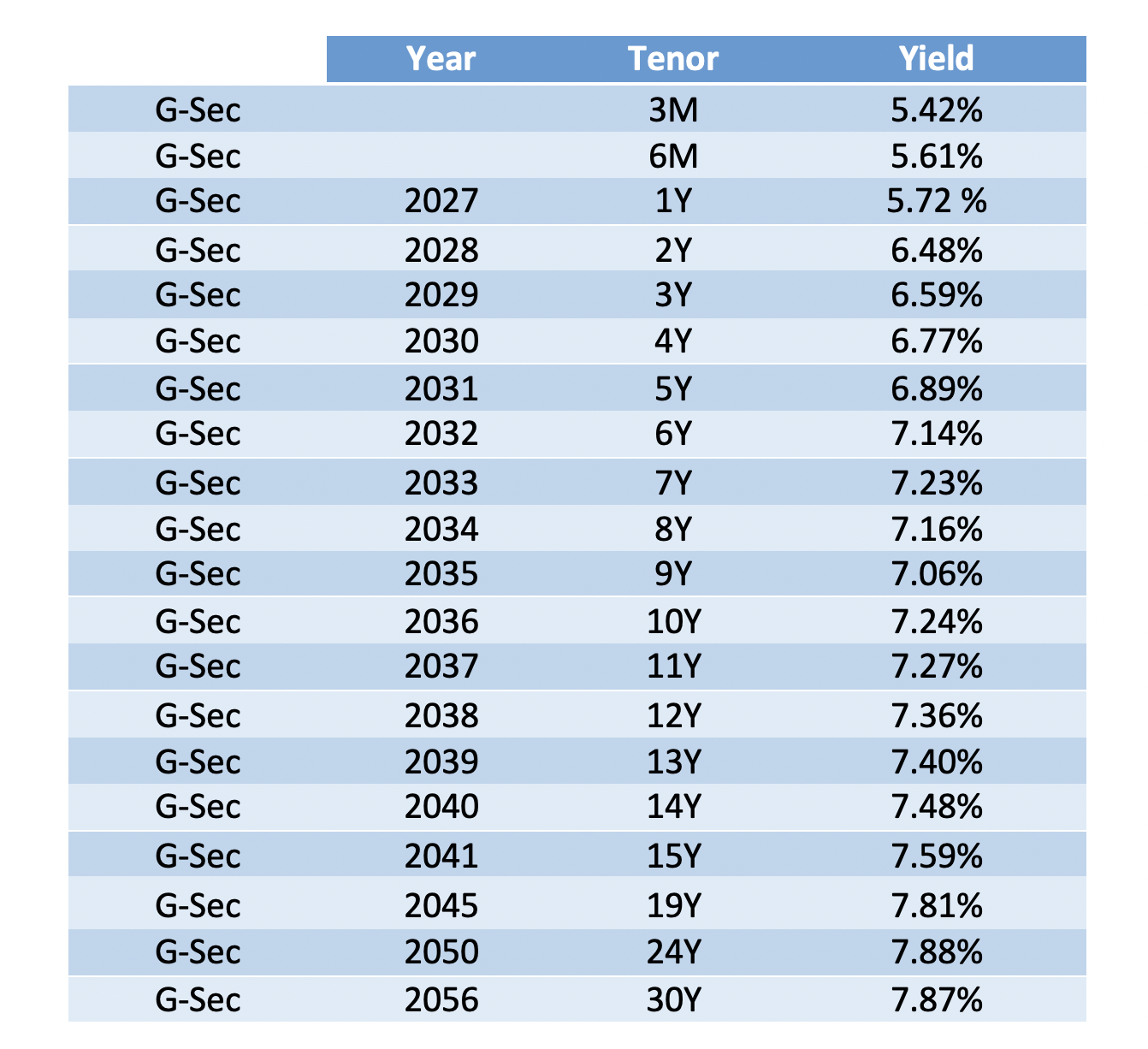
G-Sec – Government of India dated Securities.
Yield indicates annualized yield as on 31st January 2022
Sources: https://www.fbil.org.in/#/home
NOTES ON BOND RATES
1. Discount rate used in Actuarial Valuation
Discount rate used in Actuarial Valuation is based on bond yields as on end of the balance sheet reporting period – as per Para 83 of IND AS 19. Impact of change in assumption is recognized in Profit & Loss in case of AS-15 valuations, whereas in IND AS-19 valuations it is recognized through OCI (Other Comprehensive Income) and P&L will not be affected.
2. Comparing 10-Year G-Sec yields between March 2025 and March 2026
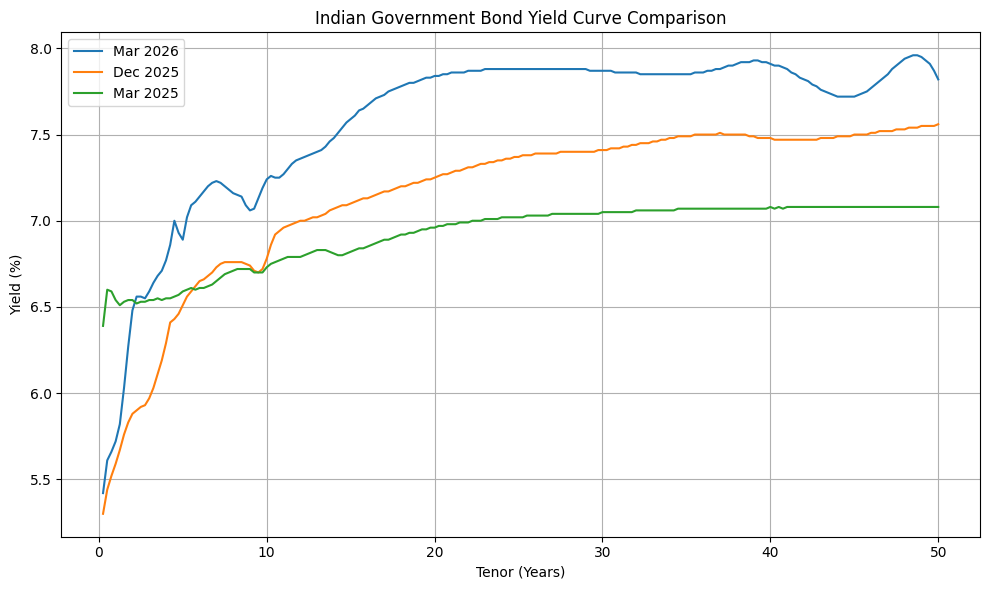 | ||||
The 10-Year Government Security yield increased from approximately 6.73% in March 2025 to about 7.24% in March 2026, representing an increase of approximately 51 basis points over the last one year.
This reflects a moderate increase in medium-term government borrowing costs. The increase in yields reflects rising long-term interest rate expectations and increased risk premium in the bond market. During early 2026, government bond markets experienced volatility amid rising global crude oil prices and geopolitical tensions, which increased inflation expectations and pushed bond yields higher.
3. Comparing Short-term (< 5 years) G-Sec yields between March 2025 and March 2026
Short-term yields have declined significantly during the period.
For example,
Tenor | Mar-2025 | Mar-2026 | Change |
3 Month | 6.39% | 5.42% | ↓ ~97 bps |
6 Month | 6.60% | 5.53% | ↓ ~107 bps |
1 Year | 6.59% | 5.70% | ↓ ~89 bps |
The decline in short-term yields reflects the easing monetary policy environment during 2025, when the Reserve Bank of India implemented a series of rate cuts totaling about 125 basis points, bringing the repo rate to around 5.25%.
Lower policy rates and liquidity support from the RBI contributed to a reduction in short-term money market rates.
4. Comparing Long-term G-Sec yields between March 2025 and March 2026
Long-term yields have increased across most maturities.
For example,
Tenor | Mar-2025 | Mar-2026 | Change |
10 Year | 6.73% | 7.24% | ↑ ~51 bps |
20 Year | ~6.96% | ~7.84% | ↑ ~88 bps |
30 Year | ~7.05% | ~7.87% | ↑ ~82 bps |
The increase in long-term yields reflects higher inflation expectations, concerns regarding global energy prices, and continued government borrowing requirements. Rising crude oil prices due to geopolitical tensions have increased inflation risks and led investors to demand higher yields on longer-duration bonds.
5. Yield curve movement
The comparison between March 2025 and March 2026 indicates:
- Short-term yields decreased sharply
- Long-term yields increased significantly
- The yield curve has therefore steepened significantly over the period
The spread between 3-month and 10-year yields increased from approximately 34 basis points to around 182 basis points. This steepening reflects the combination of monetary easing at the short end and rising inflation and fiscal expectations at the long end of the yield curve.
6. Implications for actuarial valuations
Changes in G-Sec yields have a direct impact on actuarial liabilities:
- Increase in long-term bond yields reduces the present value of actuarial liabilities due to higher discount rates.
- However, such changes may result in actuarial gains or losses in defined benefit obligations, arising from the valuation assumptions.
Adjustments to other actuarial assumptions such as salary escalation rates should be made cautiously and only after consultation with the actuary and management, considering long-term HR and financial implications.
Disclaimer: The information provided in this document is for informational purposes only, and the same may be incomplete, incorrect or outdated. None of the information provided herein should be used to replace official documents, nor shall it be used to substitute the advice of a qualified professional. Nothing herein constitutes a contract, an agreement or any other form of legal binding with the representatives of Armstrong International. No representative of Armstrong International is liable in any body of law, for anything stated herein. Any references herein do not imply endorsements or support of the referred products or services
